

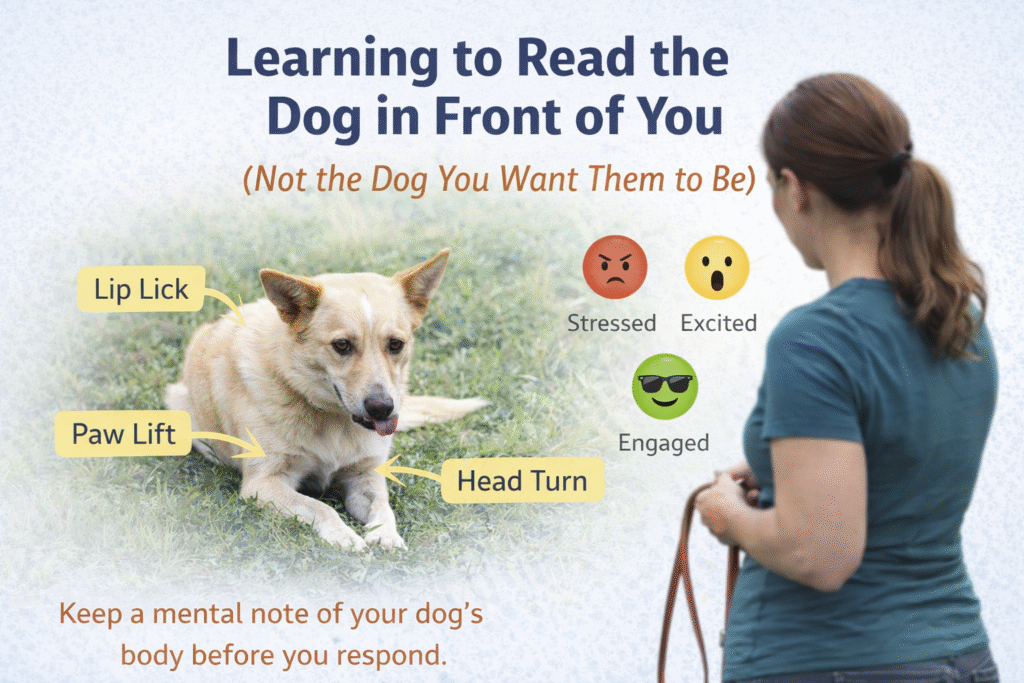
One of the biggest shifts a dog owner can make is learning to see the dog in front of them, not the dog they hope or expect to see in that moment.
Behavior doesn’t happen in isolation. Every choice your dog makes is influenced by their emotional state, environment, past experiences, and the information they’re receiving from you. When we slow down and truly observe, training becomes clearer, kinder, and far more effective.
Stress, Excitement, or Engagement? Knowing the Difference Matters
Many behaviors look similar on the surface but come from very different emotional places.
- Stress often shows up as avoidance, tension, shutdown, or frantic movement.
- Excitement may look like jumping, vocalizing, spinning, or pulling—but can still limit learning.
- Engagement is what we’re aiming for: a dog that is curious, responsive, and able to think.
When we misread stress or over-arousal as “energy” or “attitude,” we often ask too much—and that’s when behavior falls apart.
Subtle Signs Many Owners Miss
Dogs communicate constantly, but much of their language is quiet and easy to overlook. Some of the most important signals happen before big behaviors appear.
Watch for:
- Lip licking or tongue flicks (especially when no food is present)
- Freezing or slowing movement
- Head turns or looking away
- Paw lifts
- Yawning outside of sleep contexts
- Sudden sniffing or disengaging
These are often early indicators of stress, uncertainty, or rising arousal. Catching them early allows you to adjust before your dog hits their limit.
Behavior Doesn’t Exist in a Vacuum
A dog who can perform a behavior perfectly at home may struggle in a new environment—and that doesn’t mean they’re being stubborn or disobedient.
Consider what’s influencing your dog in the moment:
- Environment (location, noise, movement)
- Physical needs (rest, hunger, discomfort)
- Emotional state (confidence, stress, excitement)
- Recent experiences
When we ignore context, we often place expectations on dogs they simply can’t meet yet.
Matching Expectations to Emotional State
Training is most successful when expectations match what the dog is capable of in that moment.
A dog who is:
- Over-threshold may need distance or decompression
- Mildly stressed may benefit from simpler tasks
- Calm and engaged can handle new challenges
Adjusting expectations isn’t lowering standards—it’s setting your dog up to succeed.
Practical Skill: Pause and Assess
Before asking your dog for a behavior, try this:
- Pause for a moment
- Scan your dog’s body—ears, mouth, eyes, movement
- Ask yourself: Are they able to think right now?
If the answer is no, adjust the environment, your handling, or your expectations.
Identifying Threshold Moments
A threshold is the point where a dog can no longer process information effectively.
Common signs a dog is approaching threshold:
- Faster movements or frantic behavior
- Ignoring known cues
- Increased vocalization
- Freezing or sudden shutdown
Learning to recognize threshold moments allows you to step in early rather than reacting after things escalate.
Reading Arousal Levels in Real Time
Arousal isn’t good or bad—it simply needs to be appropriate for the task.
Ask yourself:
- Is my dog escalating or settling?
- Are their movements loose or tense?
- Are they able to disengage and re-engage?
These questions help guide your next decision more than any command ever could.
Training Starts With Observation
When you learn to read your dog’s body language, training becomes a conversation instead of a power struggle. Progress happens faster when dogs feel understood.
Start keeping a mental note of what your dog’s body is telling you before you respond.
Next week, we’ll explore how leash handling, timing, and space create an invisible conversation between you and your dog.
Next Step K9 Center provides relationship-based dog training and behavior modification services in Oklahoma, offering both in-person and virtual support for dogs and their people.