

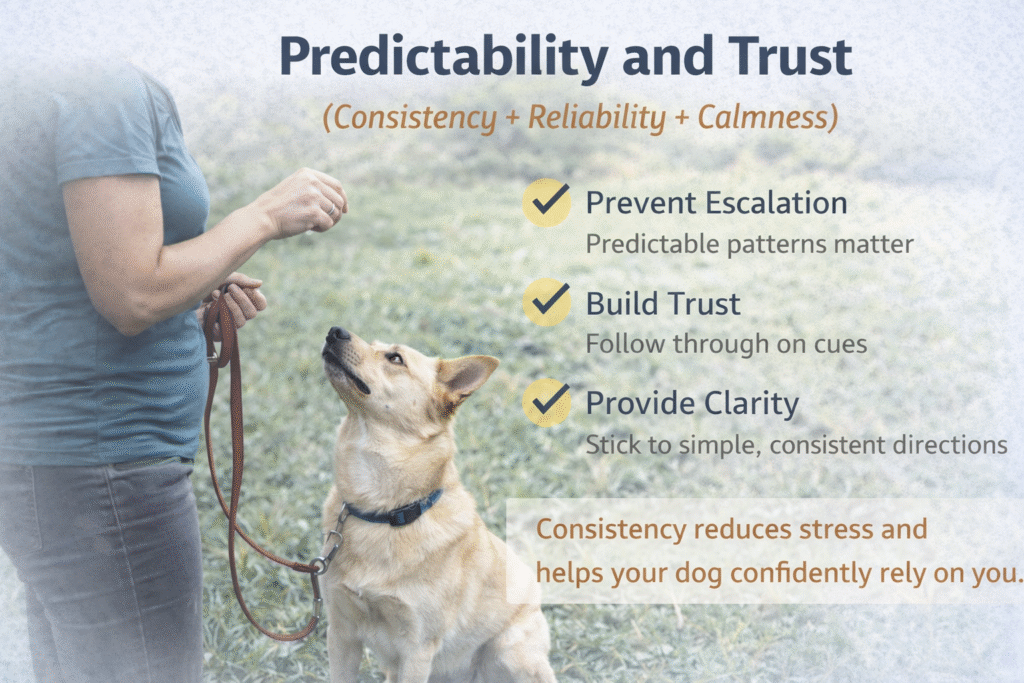
Training doesn’t fall apart because dogs are stubborn or unmotivated. More often, it breaks down when handlers are inconsistent, unpredictable, or unclear under pressure.
After focusing on body awareness (Week 1), emotional observation (Week 2), and mechanical skills like leash handling, timing, and space (Week 3), we arrive at the most important piece of the puzzle:
predictability and trust.
Why Predictability Matters to Dogs
Dogs are constantly scanning their environment for information. When their handler is predictable, the world feels safer—and safer dogs make better decisions.
Predictability doesn’t mean rigidity. It means your dog can reliably anticipate:
- How you will respond
- What information the leash provides
- When pressure will turn off
- What behaviors are likely to be reinforced
When those patterns are clear, dogs don’t need to guess.
Trust Is Built in the Small Moments
Trust isn’t created during formal training sessions alone. It’s built during everyday moments:
- How you respond when your dog hesitates
- Whether you notice early stress signals
- If you step in before your dog goes over threshold
- How quickly you release pressure when your dog tries
Dogs learn whether they can rely on you long before they learn commands.
Consistency Over Intensity
Many handlers unintentionally create confusion by being very structured one day and reactive the next.
Consistency means:
- Similar responses across situations
- Clear start and end points to behaviors
- Predictable use of the leash
- Emotional neutrality during mistakes
Intensity—raising your voice, tightening the leash, rushing—often signals uncertainty, not leadership.
Reading, Then Responding
A trustworthy handler observes first and responds second.
Before asking for a behavior, pause and ask:
- What emotional state is my dog in right now?
- Are they under, at, or over threshold?
- Is the environment supporting success?
This pause is often the difference between progress and frustration.
Allowing the Dog to Think
Dogs build confidence when they are allowed to problem-solve.
That means:
- Giving space when appropriate
- Avoiding constant micromanagement
- Letting good choices unfold
Stepping back doesn’t mean disengaging—it means trusting the foundation you’ve built.
Putting the Series Together
Strong handling skills come from layering:
- Awareness of your own body and movement
- Accurate reading of canine emotional states
- Clean mechanical skills with leash, timing, and space
- Predictable, thoughtful responses
When these pieces work together, training becomes calmer, clearer, and more effective.
Final Thought
Your dog doesn’t need perfection. They need consistency, clarity, and a handler they can rely on.
Start asking yourself not just what you want your dog to do—but what you are communicating in every interaction.
Next Step K9 Center offers relationship-based dog training and behavior modification with in-person and virtual services available throughout Oklahoma.