

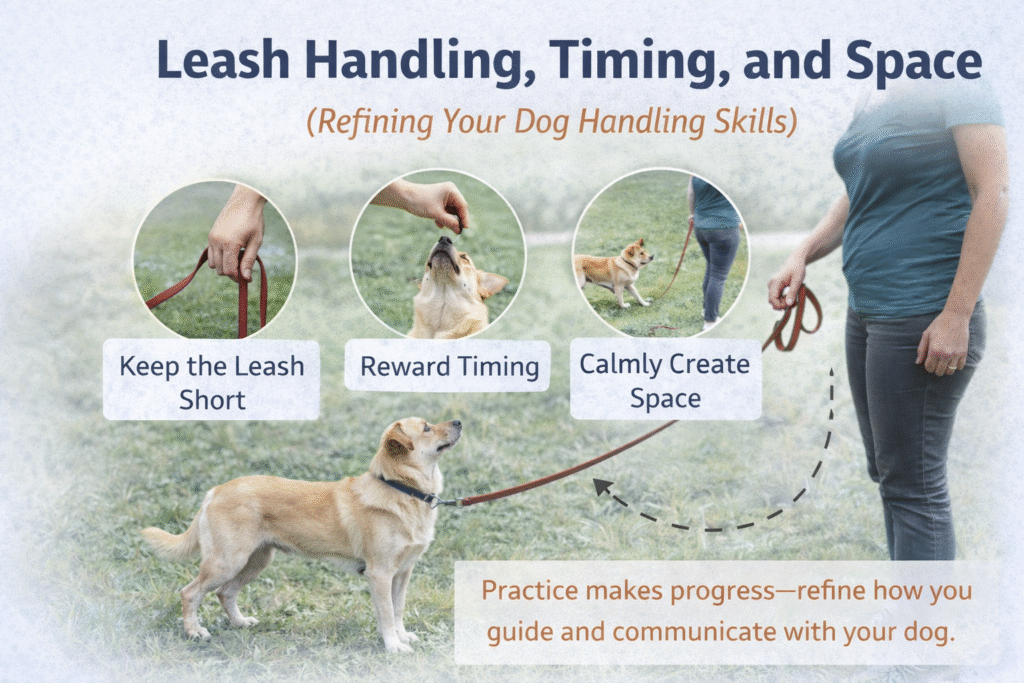
By the time most handlers realize something has gone wrong on a walk or in training, the conversation has already been happening for several seconds—quietly, through the leash, body position, and movement.
Leash handling isn’t about control. It’s communication. And when timing and use of space are unclear, dogs are left guessing.
This week, we’re focusing on the invisible conversation between you and your dog—and how improving mechanical skills can dramatically improve behavior.
The Leash Is Always Talking
Whether it’s tight or loose, moving or still, the leash is constantly giving your dog information.
Common problems we see:
- Constant low-level tension that keeps dogs in a heightened state
- Accidental corrections caused by poor timing
- Using the leash to manage emotions instead of information
Dogs don’t interpret leash pressure as “obedience.” They interpret it as direction, restriction, or concern.
Clean Leash Handling vs. Accidental Pressure
Clean leash handling means the leash is:
- Neutral when nothing is being asked
- Purposeful when information is given
- Released immediately when the dog responds
Accidental pressure happens when handlers:
- Hold tension without realizing it
- React late instead of early
- Use strength instead of movement
The goal is clarity—not force.
Timing: Why Seconds Matter
Dogs live in the moment. A reward, release, or correction that happens even a second too late can change the meaning entirely.
Good timing means:
- Marking the exact moment the dog makes a good choice
- Releasing pressure the instant the dog responds
- Moving your body when your dog is still thinking—not after they’ve committed
Poor timing often looks like dogs who “know the behavior” but can’t perform it reliably.
Space Is a Training Tool
Distance and positioning are powerful—and often underused—training tools.
You can use space to:
- Lower arousal
- Increase clarity
- Prevent threshold moments
- Support better choices
Stepping away, changing direction, or increasing distance often communicates more effectively than pulling on the leash.
When to Step In and When to Step Back
Effective handling is knowing when to influence the situation and when to allow the dog to work it out.
Step in when:
- Your dog is approaching threshold
- The environment is too much
- Safety is at risk
Step back when:
- Your dog is engaged and thinking
- They are offering appropriate behavior
- Exploration is helping regulation
Practical Skill: Movement Over Muscle
Instead of tightening the leash, try:
- Turning your body and inviting the dog with you
- Creating an arc rather than a straight pull
- Using direction changes to reset focus
Dogs follow movement more naturally than pressure.
Putting It Together
Leash handling, timing, and space form a quiet but constant dialogue. When that dialogue is clear, dogs feel safer—and safer dogs make better choices.
Next week, we’ll bring everything together and focus on becoming a predictable, trustworthy handler your dog can rely on in real life.
Next Step K9 Center offers relationship-based dog training and behavior modification in Oklahoma, with in-person and virtual services available.